Compounded Low-Dose Atropine for Pediatric Myopia: What Eye Care Providers Should Know
This is a subtitle for your new post
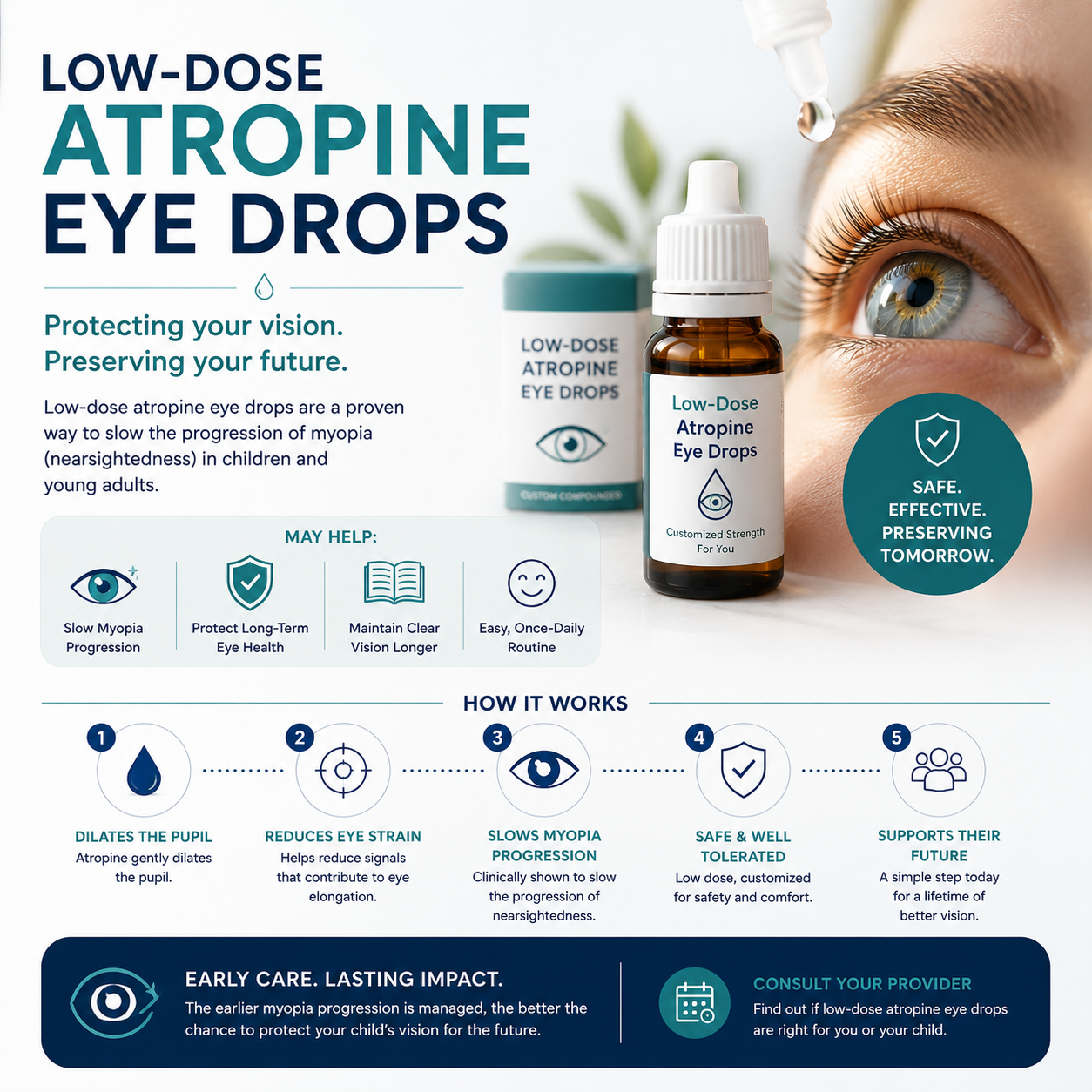
The evidence for low-dose atropine in pediatric myopia management has become difficult to ignore. Studies from the ATOM and LAMP trials have consistently demonstrated meaningful reductions in axial elongation at concentrations of 0.01% to 0.05%, with a favorable safety and tolerability profile that supports long-term use. As you integrate myopia management protocols into your practice, partnering with a reliable compounding pharmacy is one of the most important operational decisions you will make.
Why Compounding Is Essential for This Treatment Category
Low-dose atropine is not available as a commercially manufactured product in the concentrations most clinically utilized for myopia management. FDA-approved atropine formulations remain at 1% concentration, creating a significant gap between what the evidence supports and what is commercially available. Compounded atropine — prepared at 0.01%, 0.025%, or other prescribed concentrations — fills that gap. A 503A compounding pharmacy operating under USP 797 standards can prepare sterile, preservative-free atropine in unit-dose or multi-dose vials suitable for pediatric ocular use.
What to Look for in a Compounding Partner
Not all compounding pharmacies have the infrastructure or quality systems for sterile ophthalmic preparations. When selecting a pharmacy to compound atropine eye drops for your patients, verify that the pharmacy meets USP 797 sterile compounding standards, has an ISO-classified cleanroom environment, conducts sterility and potency testing, and offers shipping solutions that maintain product integrity. Kearney Park Pharmacy in Mesquite, Texas, compounds low-dose atropine under these standards and ships across the state of Texas with appropriate cold chain packaging.
Streamlining the Prescription Workflow
One of the most common barriers to incorporating compounded atropine into practice is the perceived complexity of the prescribing and ordering process. In practice, it does not have to be complex. Kearney Park Pharmacy accepts faxed prescriptions and works directly with patients on insurance questions and refill scheduling. We recommend providers clearly write the concentration, base vehicle, quantity, and refill authorization on the prescription to minimize callbacks. We also offer coordination with provider offices on prescription status and refill reminders.
Concentration Selection and Monitoring
Current evidence suggests that 0.05% atropine offers a stronger effect on axial elongation reduction compared to 0.01%, though with slightly higher rates of mild photophobia and accommodative effects. The LAMP2 trial data supports 0.05% as a viable first-line concentration in many patients. Clinical judgment regarding the starting concentration should incorporate the patient's baseline rate of progression, severity of myopia, and family history. Annual refraction and axial length measurements remain the standard for evaluating treatment response.
Shipping Across Texas for Your Patients
Many of your patients may not have convenient access to a compounding pharmacy near their home. Kearney Park Pharmacy provides shipping of compounded atropine eye drops directly to patients across Texas, making it easy for practices in Dallas-Fort Worth and beyond to offer this therapy without geographic limitations.
Partner with Kearney Park Pharmacy
If you are building or expanding a myopia management program and need a reliable sterile compounding source for low-dose atropine, we would like to be your pharmacy partner. Call us at 972-329-1168 or fax prescriptions to 972-329-1436. We welcome lunch-and-learn discussions with your practice team and can provide patient education materials to support your protocol.